
CardFindr
Finds subscriptions, trials and renewals from bank statements and receipts, maps them to cards, and guides cancellation.
- TEFY's role
- Product, design, engineering, AI evaluation, compliance documentation
- Related service
- Build AI agents
- Stack
- Next.js, Supabase with RLS, Vercel AI SDK with Anthropic models, Inngest, Playwright and Vitest
- Timeframe
- Dates to be confirmed
The problem
People lose money to subscriptions they forgot and trials that quietly convert. Finding them means reading statements line by line. CardFindr does that reading, without ever holding a full card number.
How it works
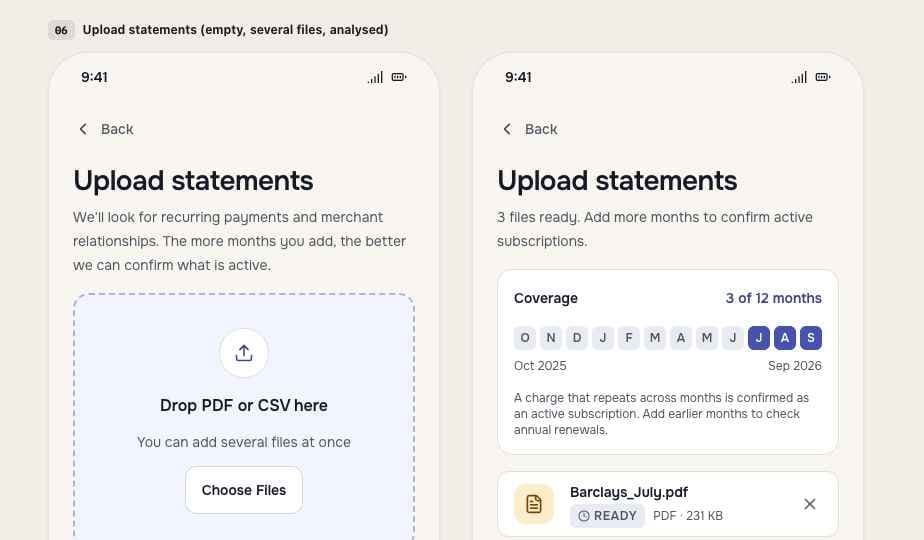
- 01Sign up, choose a source: upload statements, forward receipts, or connect a bank read-only where available
- 02Scanning shows month coverage and which cards were found
- 03The Card Map shows every recurring relationship with its evidence
- 04Clean My Card walks through what to keep, cancel or review, and drafts cancellation emails for the user to send themselves
AI functionality
Extraction of merchants, amounts and dates from statements and receipts; merchant resolution; and "Ask Card Finder", a grounded assistant that answers from the user's own data, labels its answers as AI-generated, and declines to give financial advice. All of it runs against an evaluation suite in the repository.
Engineering decisions
- Only the card network and last four digits are ever stored; statements are redacted in memory before persistence or any model call
- Raw email bodies and statement files are deleted after processing; the app never sends, edits or deletes email
- Unverified merchants are shown as "Unknown" rather than guessed
- Money is stored as integer minor units with a currency and never summed across currencies
- Bank connections are behind a provider-independent interface, proven by a test suite that runs against a second fake provider
Outcomes
Not yet launched. Detection accuracy is tracked by the evaluation suite during the build; public figures will be shared after launch.